On 15 December 1902, Elisabetta Castelli was killed at Blocton while tending the small shop that also served as her home. That morning, her husband was working in a mine. Newspaper reports followed the robbery, murder and prosecution, while her gravestone remembered the violence of her death and the grief of her husband and son.
The epitaph is particularly significant for the coexistence of Catholic mourning and an explicit racial accusation. The family’s grief was expressed through a religious language inherited from Italy, but it also incorporated the racial distinctions of Jim Crow Alabama.
The newspaper accounts examined below provide further evidence of how race and ethnicity shaped the reporting of the murder, the subsequent trial and the execution of Ed Walker, who was convicted of killing Castelli.
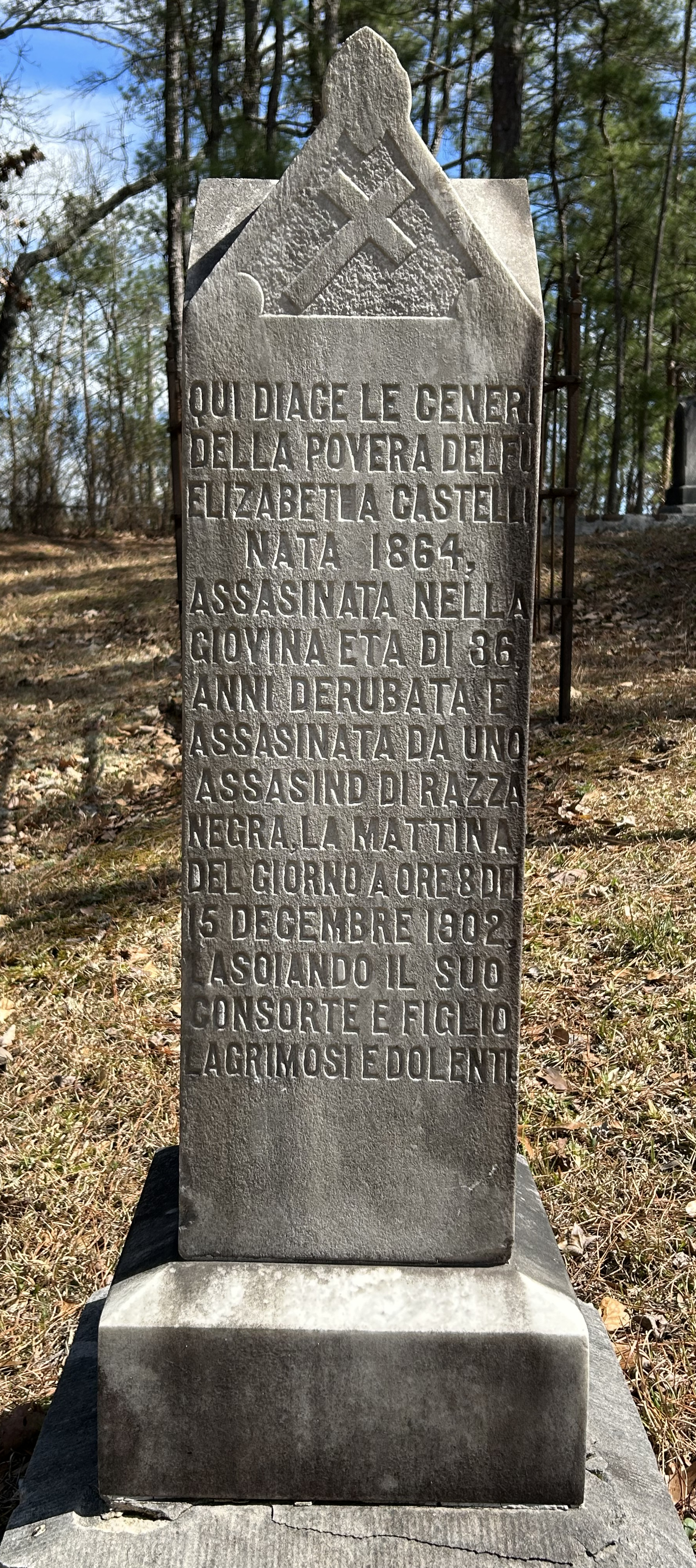
The inscription identifies Castelli’s killer only as an “assassino di razza negra”. In Jim Crow Alabama, this emphasis on the assailant’s Blackness can be read as an implicit claim to whiteness for the victim and her family. The racial accusation became part of her remembrance, preserved for visitors and later generations alongside the account of her suffering. Italians were not simply subjected to racial judgments: they could also adopt and perpetuate them in commemorating their dead.
The tombstone refers to Elisabetta as “povera,” emphasizing the tragedy of her violent death. Its closing words, ‘lagrimosi e dolenti’, describe the grief of her husband and son, left to mourn her loss, and echo the Salve Regina, a Catholic prayer addressed to the Virgin Mary, in which the faithful describe themselves as “gementes et flentes in hac lacrimarum valle” (groaning and weeping in this valley of tears). Although the epitaph does not quote the prayer directly, it draws on a familiar devotional language of mourning, also reflected in the cult of the Madonna Addolorata and the religious observances of Holy Week. These expressions gave the family a shared religious language for its loss. Beneath the carved cross, however, Christian compassion accompanies an explicit racial accusation. The family remembered Castelli through its Catholic faith without setting aside the racial divisions of the society in which it lived.

Reporting on the murder of Elisabetta Castelli, The Centreville Press located the crime in “Dago Town”, the derogatory name given to Blocton’s Italian neighborhood. The newspaper did not describe its position within the town, but the Italian settlement lay between the white residential district, which extended along the main road, and the Black neighborhood situated behind it, closer to the mining area. This physical separation reflected the ambiguous position of Italian immigrants within the segregated South: neither fully accepted by the established white population nor subjected to the same racial classification as African Americans. The geography of Blocton thus offers a particularly revealing example of Italians’ status as racial in-betweeners.
According to the newspaper, Castelli had been killed with a hatchet, and the assailant or assailants had broken open the shop’s cash drawer and an upstairs trunk, stealing several hundred dollars. Two Black men, Ed Walker and Monroe Jackson, were arrested and taken to the county jail at Centreville. The authorities reportedly believed they had sufficient evidence to convict one or both suspects, although neither had yet been tried. Walker subsequently became the principal defendant, while Jackson disappeared from the newspaper accounts examined here. His subsequent fate remains uncertain.
Particularly revealing is the newspaper’s praise of Blocton’s residents, especially the “foreign element,” for allowing the law to take its course. The remark suggests that an outbreak of retaliatory violence was a genuine concern, especially in a region where lynching remained a constant threat to African Americans accused of crimes against whites. At the same time, the Italians’ restraint was singled out as evidence of respectable civic conduct. The article thus described a community that was still identified as foreign, even as its response to the murder was judged according to the expectations of white Southern society.

A few days before his execution, the twenty-four-year-old Ed Walker received a newspaper reporter in his cell. The journalist found him reading a large family Bible and described him as “above the average in intelligence”, a qualification revealing the racial assumptions through which Black defendants were often portrayed. Walker denied murdering Castelli, claiming that a white man named William Red had given him part of the stolen money to secure his silence. The reporter also mentioned evidence against him, including money and possessions belonging to the victim reportedly found in his room. Walker’s accusation remained unverified, but his denial introduced an alternative account of the crime into the public record.
The interview devoted considerable attention to Walker’s religious preparation for death. He spoke of praying for strength and courage and resumed reading his Bible after the reporter departed. Outside the cell, the gallows had already been erected. The article concluded that only the governor could prevent the execution, presenting Walker’s final hours through a combination of religious devotion, uncertainty over his statements and the approaching punishment.
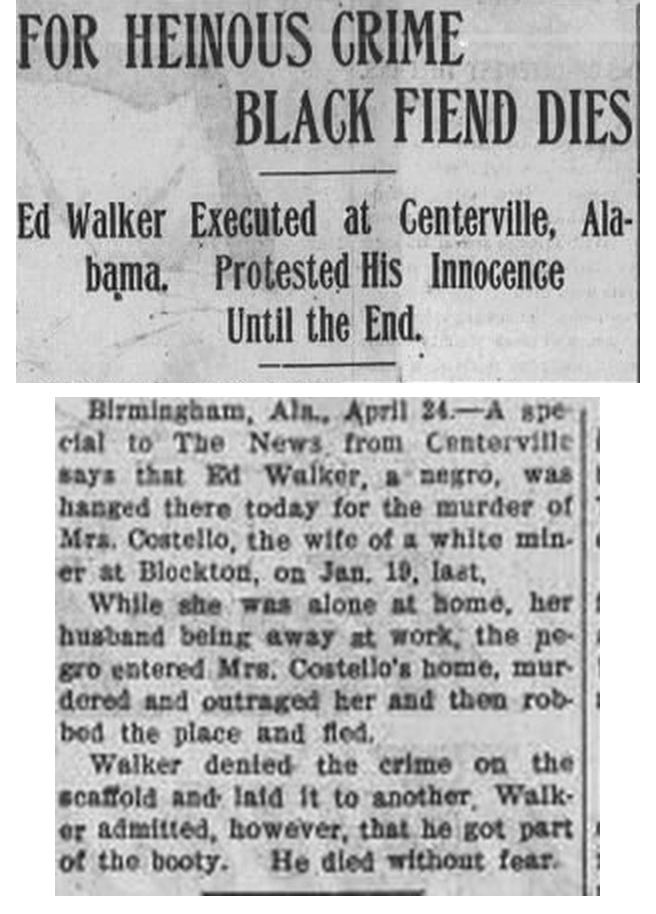
Walker was hanged on 24 April 1903. The following day, the Anniston Hot Blast reported his execution under the openly racist headline For Heinous Crime Black Fiend Dies. The newspaper also identified Castelli’s husband as a “white miner”, a significant designation in the racial context of the Jim Crow South.
The contrast with the earlier description of Blocton’s “foreign element” is particularly instructive as Italians could remain targets of ethnic prejudice while being recognized as white within the legal and social hierarchy of segregation. The identification of Castelli’s husband as white, set against the repeated racial condemnation of Walker, illustrates how racial categories entered the public narration of the crime and its punishment. The report acknowledged Walker’s protestations of innocence, but its headline cast the execution as the deserved punishment of a Black criminal.
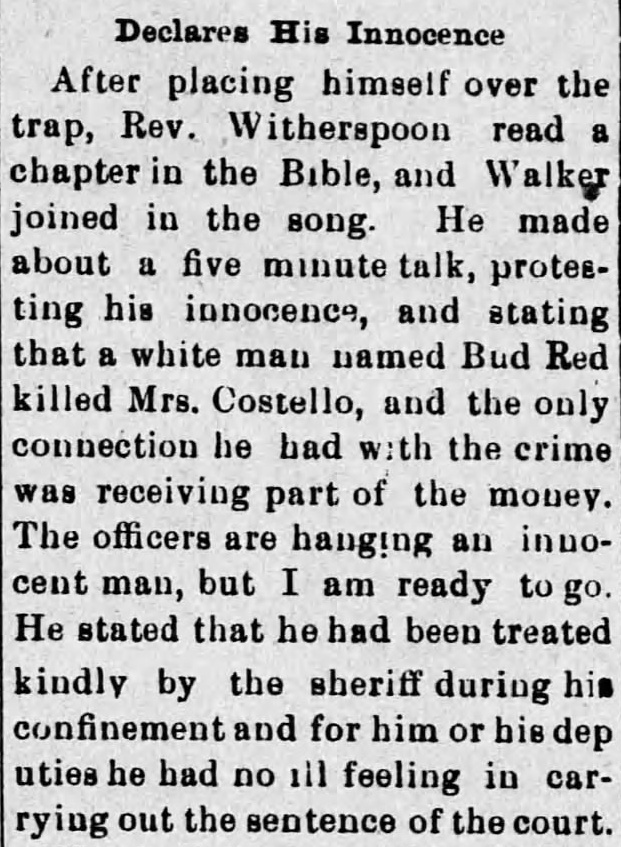
A fuller account published in The Centreville Press described Walker’s final moments, including Reverend Witherspoon’s reading from the Bible and the condemned man’s participation in religious singing. Walker again protested his innocence, naming a white man called Bud Red as the person responsible for Castelli’s murder. His reported declaration, “The officers are hanging an innocent man”, was recorded even as the newspaper described the completion of his sentence. The different names appearing in the reports, William Red and Bud Red, preserve Walker’s accusations without establishing the identity or guilt of the man he implicated.
The religious elements of Walker’s execution offer an additional perspective on the case. Prayer, scripture and expressions of suffering appear both in the Catholic epitaph commemorating Castelli and in the accounts of the condemned man’s final hours. Yet the two individuals occupied sharply different positions within Alabama’s racial order. Castelli’s murder was commemorated through a language of familial grief that explicitly identified the killer as Black, while Walker’s religious observance and repeated denials appeared in newspaper reports that treated his execution as the conclusion of a racially charged criminal prosecution. If we read them together, the gravestone and the press reveal how religious devotion, racial identification and the administration of justice could coexist in the same tragic history.


