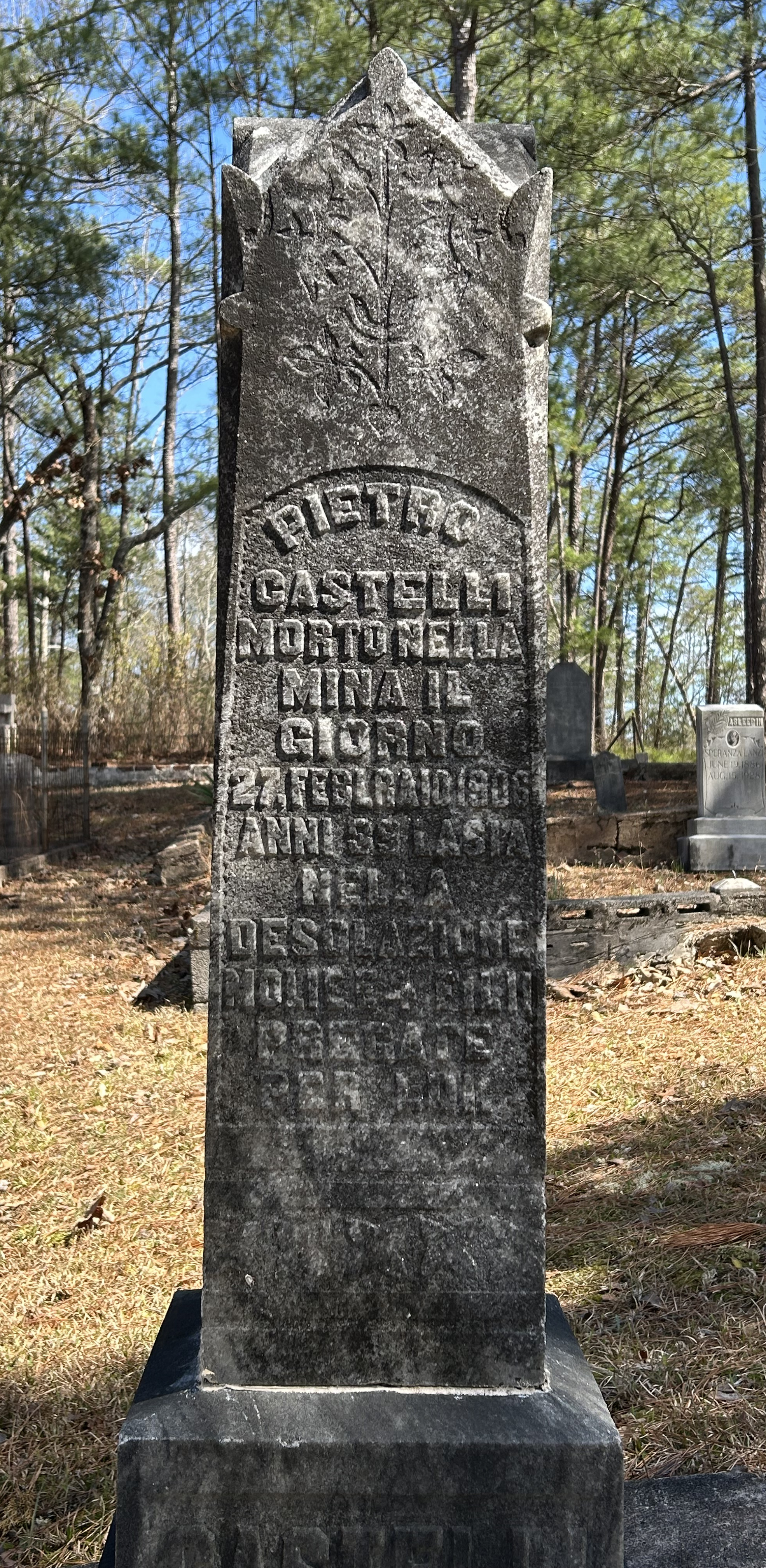
Pietro Castelli was killed at the age of thirty-three on 27 February 1906 in an explosion at the Little Cahaba Coal Company's No. 2 mine located at Piper, Alabama, a mining settlement in Bibb County, near West Blocton. Piper was one of several communities in the Cahaba coalfield where Italian immigrants worked alongside miners of other nationalities, drawn by the prospect of employment in Alabama's expanding coal industry. The work was dangerous, and fatal accidents could leave families without their principal source of income.
Castelli’s gravestone records the circumstances of his death and remembers his second wife and four children, whom he left “nella desolazione”. The inscription closes with the familiar Catholic appeal “Pregate per lui”, asking visitors to pray for his soul. The grief expressed in these words belongs as much to his surviving family as to the deceased himself. His death deprived a household of a husband and father whose work in the mines had helped support it.
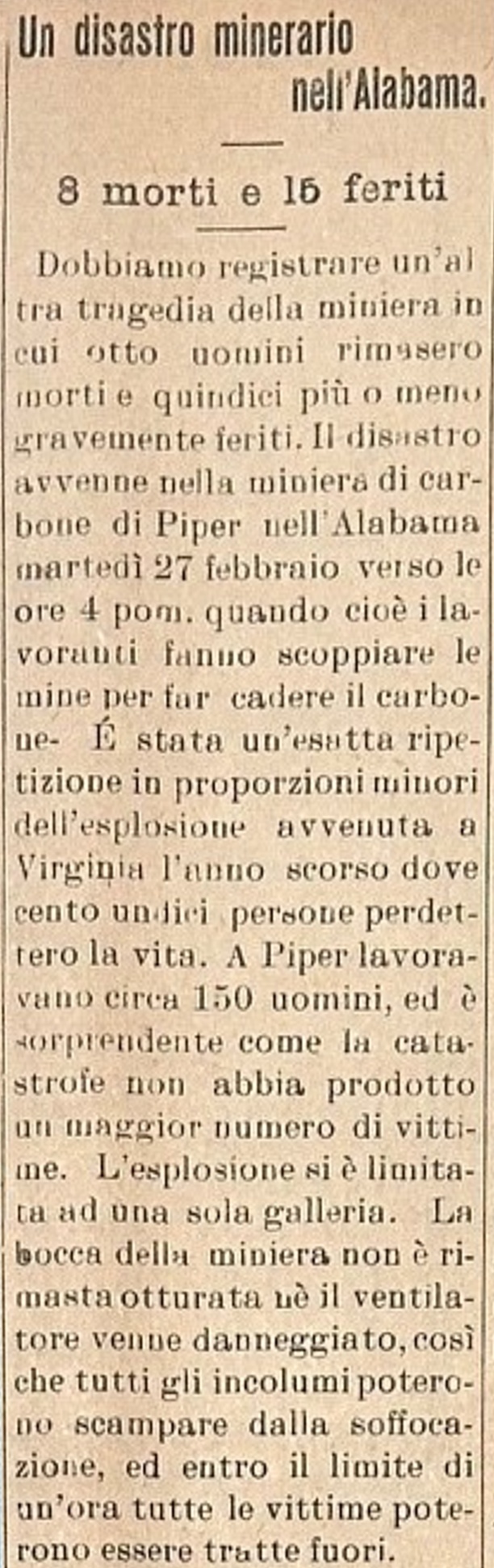
On 3 March 1906, just four days after the explosion, L’Italo-Americano, published in New Orleans, reported the disaster under the headline Un disastro minerario nell'Alabama. According to the newspaper, eight miners had been killed and fifteen injured at Piper. Among the Italian victims, the article mentions Pietro Castelli. The speed with which the news reached Louisiana reflects the connections between Italian communities in New Orleans and the mining settlements of Alabama, where migrants from different parts of Italy had found employment.
The article opened by recalling an earlier mining catastrophe at Virginia, Alabama, where 111 people had reportedly lost their lives. Piper was therefore presented not as an isolated tragedy but as another episode in a succession of deadly accidents affecting Alabama's coalfields. For readers in New Orleans, some of whom might have considered moving inland in search of better wages, these reports offered a sobering account of the risks associated with mining employment.
The causes of the explosion were disputed: some attributed it to an accumulation of gas, others to coal dust. The newspaper, however, emphasized inadequate ventilation as an underlying danger and argued that responsibility rested with the mining company. It also reported the arrival of a state inspector to investigate the accident.
Italian casualties were referred to as “nostri amici italiani.” The newspaper named the dead and injured, offered condolences to their families and wished the wounded a prompt recovery. These expressions of sympathy brought the Italian workers of Piper into the circle of the newspaper's readers, many of whom would never have met them. The deaths of men working in Alabama became a matter of concern for a community hundreds of miles away.
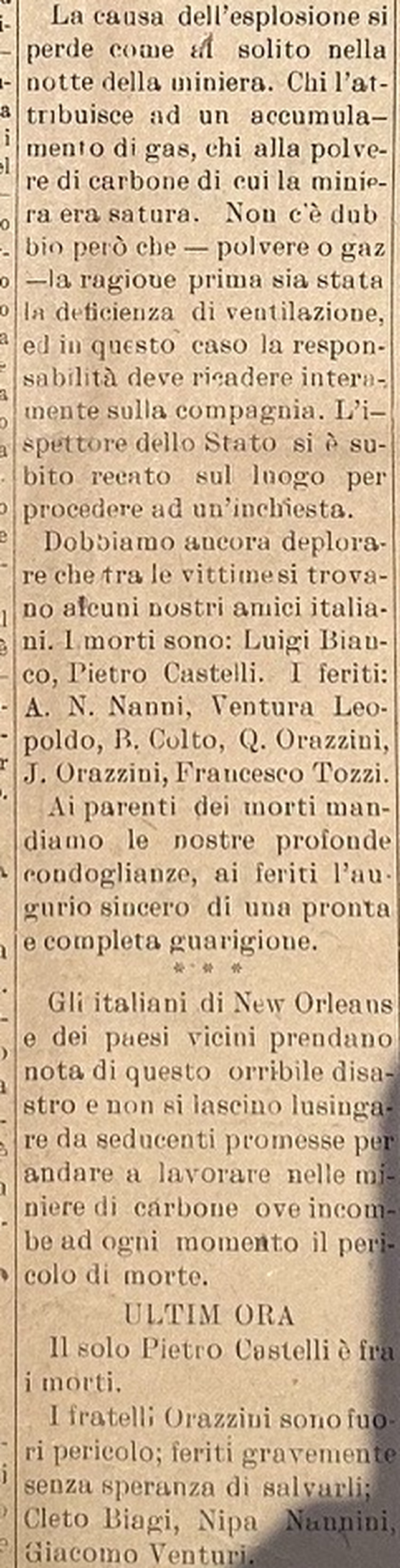
The article concluded with a direct warning to Italians in New Orleans against being tempted by attractive promises of employment in Alabama's coal mines, where, as the editors wrote, “incombe ad ogni momento il pericolo di morte”. The warning was particularly relevant in a region where recruitment and the movement of workers connected port cities with inland industrial settlements. Reports of mining disasters could influence whether migrants remained in Louisiana or sought employment elsewhere.
There may have been another consideration behind this warning. Discouraging migration to Alabama could also have helped retain workers and their families in New Orleans, where their presence sustained Italian businesses, associations and the newspaper's own readership. Concern for migrants' safety might therefore have coincided with an interest in the continued growth of the local Italian community of New Orleans. This remains a hypothesis rather than an established editorial intention; however, whatever the editors’ motives, the report illustrates how the Italian-language press connected communities across the Gulf South. News of accidents, working conditions and opportunities for employment circulated between settlements, allowing migrants to learn from the experiences of others. The editors could offer sympathy to families in Alabama while addressing practical advice to readers in Louisiana. In this way, the newspaper helped sustain a sense of community that extended beyond the boundaries of individual towns and cities, while remaining attentive to the particular interests of its own readership.
Pietro Castelli’s death was remembered in both places. His gravestone in West Blocton preserved the grief of his wife and children and asked visitors to pray for him. In New Orleans, his name appeared in a newspaper report that questioned the safety of mining work in Alabama and warned other Italians against the dangers that had cost him his life.


