A Voice for Italians Across the South

L’Italo-Americano’s masthead announces its dedication to Italian communities in the Southern states and claims to be the official organ of New Orleans’s Italian community. It names Paolo Montelepre as proprietor and gives a Chartres Street address. The motto “Labor omnia vincit” places an ethic of work within this public identity.
La Voce Coloniale Introduces Itself

The newspaper’s masthead advertises a newspaper published in Italian and English and declares its commitment to Italian communities. Subscription prices and its Decatur Street address situate that ambition in a working publishing business.
Paolo Montelepre and the Newspaper’s Public Identity


Paolo Montelepre’s portrait was reconstructed using AI because the original newspaper was badly damaged and the binding of the collected issues cut off part of the image.
This restored newspaper clipping gives a face to the publisher named in L’Italo-Americano’s earlier masthead. The accompanying profile credits Montelepre with sustaining Italian journalism in the Southern states. His later appearance as La Voce Coloniale’s publisher and editor connects the two papers through a shared figure.
The People Behind La Voce

This sworn statement identifies Paolo, here called Paul, Montelepre as publisher, editor and managing editor, and Frank Cabibi as business manager. Montelepre, Michele Mangiaracina and Cabibi appear as co-owners. Recording ownership and management as of 1 April 1918, it makes the newspaper’s editorial and financial responsibilities visible.
A Publishing Company on Camp Street

The publication panel names Giuseppe Vestri as president and editor, C. S. Aricò as business manager, and Nicola Ricciuti as advertising manager. Its Camp Street address and three-dollar annual subscription identify the practical arrangements sustaining the weekly. Dated 1922, the panel also documents the two newspapers’ overlapping publication.
Publishing and cultural association

The notice names Frank Cabibi and the estate of Michele Mangiaracina as editors and proprietors, alongside Beverly C. Polizzi as society editor. It also identifies La Voce Coloniale as the official organ of the Virgilian Society, established in New Orleans in 1931. Publishing, community reporting and organized cultural activities meet within the same institutional statement.
Frank Leo Loria and Cultural Leadership
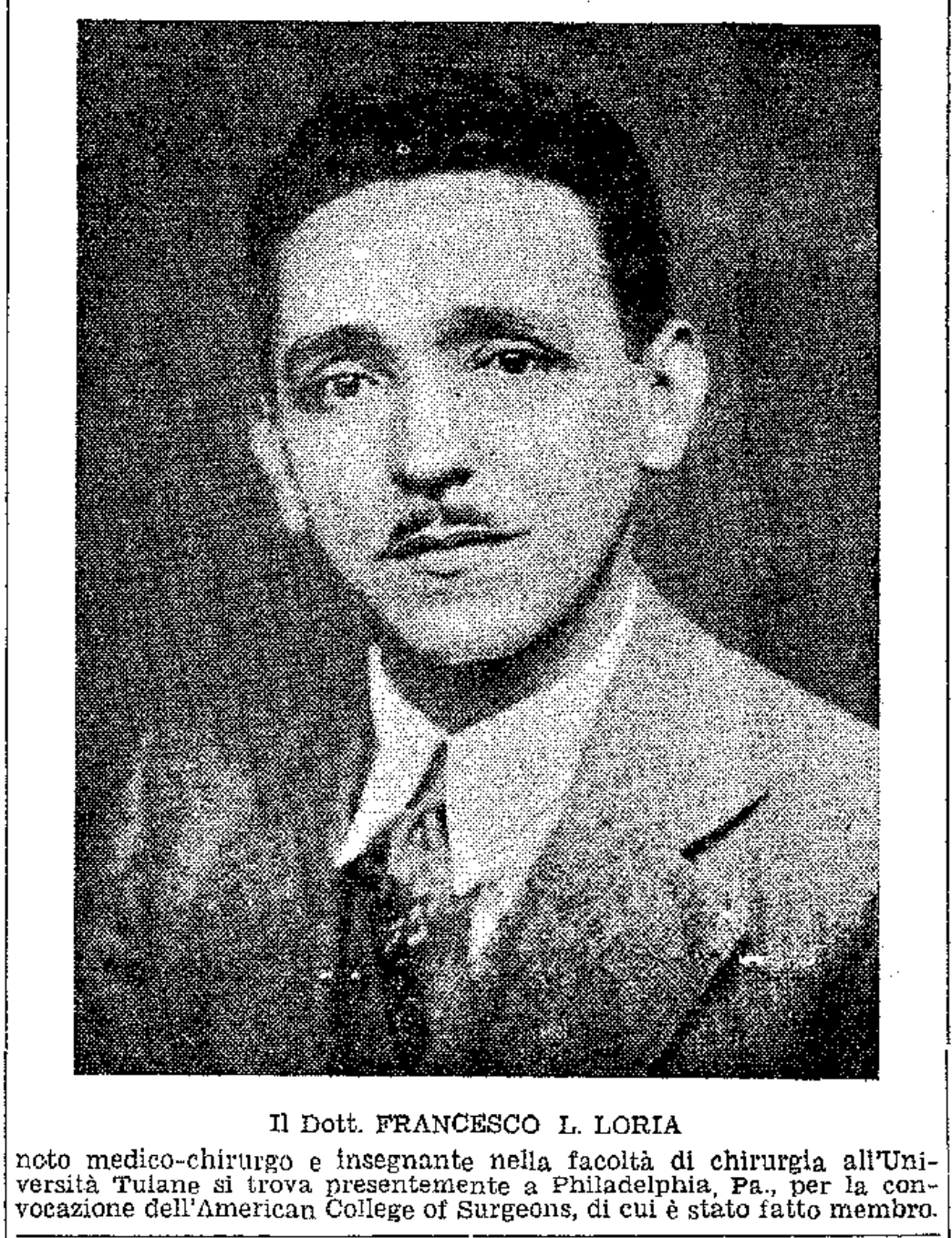
The portrait presents Loria as a physician, surgeon and Tulane teacher attending the American College of Surgeons’ meeting in Philadelphia, following his admission to membership. His honorary editorship and leadership of the Dante Alighieri Society connected these professional credentials with campaigns for Italian language and culture.


