In L’Italo-Americano, serialized fiction brought literary Italian into everyday reading, while book catalogs offered grammars, histories and popular novels alongside manuals for learning English. Readers following a story or choosing a book could encounter Italian literature and history while acquiring knowledge useful at work and in daily life in America. The newspaper gave these pursuits space on the same pages, making reading for pleasure part of a broader opportunity to learn.
Advertisements for commercial colleges and announcements of public evening classes directed readers towards English and business instruction, as well as courses that prepared immigrants for American citizenship. Italian teaching developed through the Unione Italiana, the Dante Alighieri Society, public schools, parish classrooms and universities. La Voce Coloniale followed their work through course announcements, fundraising appeals, reports of new programs and letters from teachers, showing how much depended on financial support and the efforts of organizers. Local initiatives also relied on cooperation with institutions in Italy.
As a surgeon and teacher at Tulane, Frank Loria brought professional authority to his advocacy of Italian education, which he pursued as honorary editor of La Voce Coloniale from 1931 to 1938 and president of the local Dante Alighieri Society from 1934. He argued that belonging to America was compatible with knowing Italian, drawing on Italy’s literary and classical traditions to make the case for language teaching. In the segregated South, however, this appeal to cultural prestige could also support claims of racial superiority. Consular support and the Dante network connected the work of local teachers and organizers to Fascist Italy’s cultural diplomacy.
The difficulty of securing family participation emerged in an English-language editorial published in 1934, which praised Italians’ adaptation to America while lamenting their children’s loss of Italian. In 1935, the criticism became sharper, as parental indifference was described as a failure of racial pride. The evening-school notice of 1937 again urged Italian families to send their children, even though classes and readers were free and people of every nationality were welcome. Teachers and organizations had provided opportunities to learn, but families were expected to sustain them through their children’s attendance. Education promised access and advancement while placing responsibility for cultural continuity and the community’s prestige on parents and children.
Learning Through Serialized Fiction

Through serialized fiction by Carolina Invernizio (such as Il delitto della Contessa) and other authors, the newspaper used the appeal of popular literature to cultivate readers’ loyalty, making literary consumption part of their regular reading habits. This commercial strategy also had a pedagogical dimension: drawing immigrant readers into a continuing relationship with Italian literature could encourage the cultural habits and aspirations associated with bourgeois respectability, helping the press shape its readership through entertainment.
A Bookshop Within the Newspaper

The “Libreria Economica” column in L’Italo-Americano advertised books sold through the newspaper’s own bookshop at 635–637 Decatur Street in New Orleans. Its catalog included schoolbooks, Italian grammars, manuals for learning English, histories and popular novels by authors such as Carolina Invernizio and Xavier de Montépin. Prices and ordering instructions made the column a point of contact between readers and the shop, extending the newspaper’s publishing business into bookselling. The selection combined literary entertainment with opportunities for language learning and cultural education, giving readers access to books through an institution they already knew.
English for Letters, Work and Citizenship

The newspaper’s bookshop advertised a 352-page Italian–English grammar for one dollar. Thirty lessons, a conversation manual and a dictionary were supplemented by 120 model letters, including correspondence for workers and businesses, and material on citizenship. Pronunciation represented through Italian spelling helped make English accessible to Italian readers, linking language study with practical tasks in employment, commerce and civic life.
English Instruction and the Promise of Employment

Soulè College promoted individual attention for Italian students and promised that its English or commercial course could secure a good position. Day and evening classes accommodated different schedules, while women were admitted to every department. Evening English cost five dollars a month. The advertisement presented paid instruction as an investment in employment and assured students behind in their studies that they could still learn.
English and Civic Knowledge Through Public Schools

This notice invited foreign-born residents to learn English and the knowledge of government needed to become American citizens. It advertised free books and directed readers to evening classes in New Orleans and Americanization schools elsewhere in Louisiana. Printed in Italian, the invitation used the immigrant newspaper to bring publicly supported civic education within readers’ reach.
Dante and the Education of the Next Generation

A portrait of Dante accompanied an appeal for Italians to enroll their children at the Unione Italiana’s school, at 1020 Esplanade Avenue. The advertisement described Italian schools as teaching young people to love the homeland and safeguarding national greatness. Sending children to class was thus presented as a parental duty toward Italy, linking decisions about their education to a collective patriotic cause. The poet’s image made literary prestige a visible argument for transmitting language and patriotic attachment to the next generation in New Orleans.
Women Raising Funds for Italian Classes
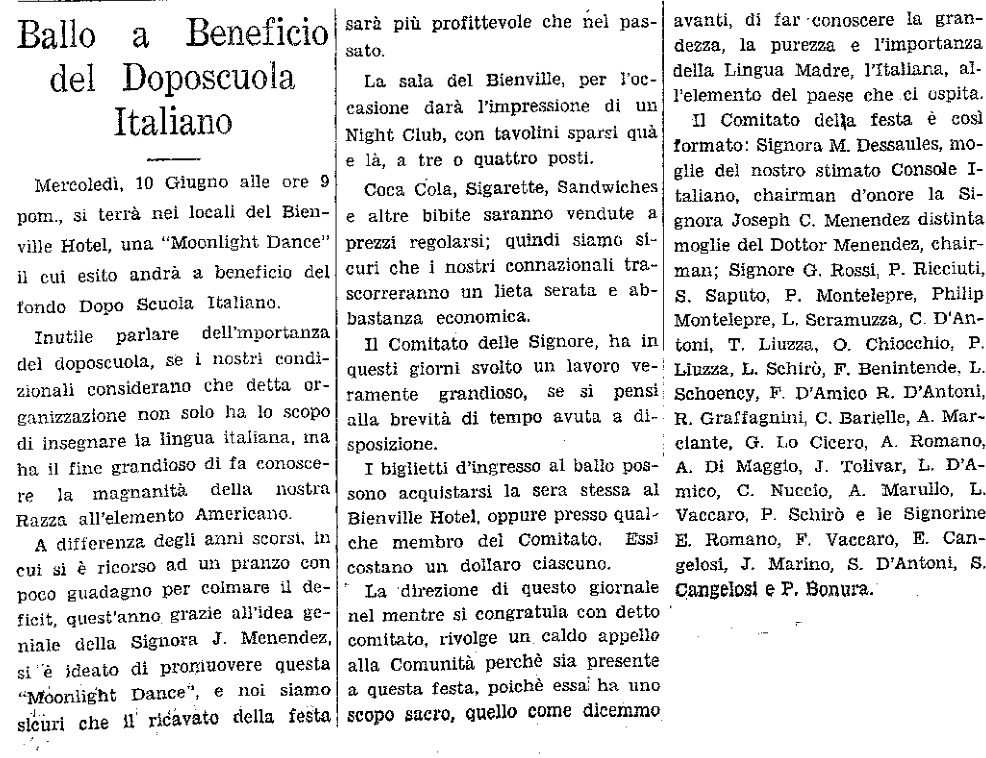
A women’s committee announced a Moonlight Dance at the Bienville Hotel to support the Italian after-school fund. Mrs Joseph C. Menendez proposed the event, with one-dollar admission, as a more profitable alternative to earlier fundraising dinners. The newspaper urged participation and linked language teaching with making the virtues of the Italian “race” known to Americans.
Italian enters the University Curriculum

Louisiana State University would introduce Italian in its 1932–33 curriculum following state funding. The newspaper credited Consul Gallina and George Piazza, president of the Virgilian Society, with securing the change, and reported a promised literature class. Congratulations from New Orleans’s “Italian Fascist Press” connected academic recognition with the political identity claimed by those promoting the language.
Loria’s Case for Teaching Italian

Writing as “AIROL”, his nom de plume, Frank Loria challenged the claim that foreign-language teaching wasted school time, arguing that it broadened children’s outlook and formed an essential part of their education. He criticized the neglect of Italian in the South and called for it to receive the same recognition as French and German. Italy’s achievements in literature, science and medicine supplied his argument for making Italian part of the education of younger generations.
Learning English, Losing Italian

Another editorial signed “AIROL” rejected claims that Italians were difficult to Americanize, arguing that they learned English readily. Yet it lamented children’s loss of Italian and criticized exclusion from the social contacts that enabled adaptation. Its account of Italian contributions to American history presented linguistic integration and ancestral pride as compatible, while using racial imagery to explain the nation’s strength.
Racial Pride and the Italian Classroom

The Need for Racial Pride, again signed “AIROL,” connected advocacy for Italian in schools with claims of Italian racial superiority. It criticized parents who failed to support language classes and credited Americans of other origins with helping the campaign. Insisting that Italians were thoroughly Americanized, the editorial nevertheless made ancestral pride an obligation to sustain Italian language and culture.
Italian Teaching Across Public and Parish Schools

This notice reported Italian classes at sixteen public schools, alongside instruction at St Mary’s parish school and the Sacred Heart convent. Evening courses at Italian Hall and in Kenner, LA, extended the network to older students. Parents were urged to use these opportunities, while the language’s literary and practical value was presented as a reason to study it without hesitation.
The People and Funds Sustaining the Schools

Italian-language teachers thanked Consul Ludovico Censi and their director, Cleofe Forti, for material and moral support. Their letter praised the effort required to assemble salaries and keep payments punctual, revealing the financial work behind the classes. As Censi prepared to leave, the signatories hoped his successor would give the schools the same care.
Free Instruction and an Appeal to Parents

The Unione Italiana’s evening school offered free courses and readers at 1020 Esplanade Avenue, with classes for beginners and advanced students. Open to adults and young people of all nationalities, it had previously enrolled more non-Italians than Italians or their descendants. The notice urged parents to make their children attend, connecting language study with the community’s prestige before other Americans. The school’s openness to non-Italians gave Italian a place in the city’s wider cultural life. At the same time, the appeal treated its transmission to younger generations as a responsibility shared by families and community institutions.


