The parish notices and appeals for assistance published in L’Italo-Americano and La Voce Coloniale connected Italian families with institutions offering help with illness, housing, employment and the care of children. An Italian parish’s advertisement in 1898 included free funeral rites for the poor among its regular services, while Italica Gens offered job placement, medical visits and help with correspondence in 1912. Alongside these institutional provisions, appeals for individual families asked readers to respond to needs that remained unresolved, making assistance to others a responsibility shared by those with the means to contribute.
The 1918 memorial to Mother Cabrini and the account of her mission’s fiftieth anniversary in 1942 described religious work that reached into immigrants’ homes and workplaces. Her sisters educated orphan girls, taught parish pupils and visited the sick, extending their activities to the French Market, wharves and fishing boats. The arrangement for fishermen to attend Mass at two in the morning shows how this ministry adapted to the demands of working lives, allowing religious participation at hours when those men were available.
Women’s religious service and charitable work also sustained initiatives whose success depended on coordinating donations, practical knowledge and unpaid labor. During the First World War, women and girls made woolen clothing and bandages, while newspaper appeals asked readers to provide materials. Notices for orphanage fairs named women organizers and described their responsibilities, giving public recognition to their contribution. Plans for a field hospital in Italy connected local fundraising with medical care overseas, while the influenza epidemic of 1918 brought urgent instructions about hygiene, quarantine and restrictions on gatherings into the same newspaper pages.
Patronal celebrations maintained connections with Sicilian hometowns, while St. Joseph altars joined family vows to hospitality and the distribution of food to the poor. These occasions relied on households, religious societies and volunteers who supplied the money, preparation and labor needed to sustain them. Their coverage presented devotion through the obligations it created: honoring a patron saint involved gathering families and fellow townspeople, and fulfilling a vow could include preparing a meal for those in need.
Italian Worship and Free Rites for the Poor

The Italian parish at Rampart and Conti Streets advertised worship as it was practiced in the homeland. Under Rev. Gioacchino Manoritta, St Anthony of Padua offered Sunday Masses, baptisms, marriages and funerals. Its notice also promised free funeral rites for poor people. Routine religious services thus included a concrete provision for families unable to meet the costs of death.
Sicilian Devotion on Louisiana Streets

The report compared Independence, LA on St. Joseph’s Day to a Sicilian town. Food tables, Italian and American flags, Mass and a procession carried inherited devotion into Louisiana’s streets. Catholic pupils and religious brotherhoods joined the procession. The newspaper credited the Fratellanza di San Giuseppe, with about 150 members, for organizing the celebration, making collective religious duty visible beyond New Orleans.
Sickness, Children and a Plea for the Mother

Domenico Marino, a father of five, had entered Charity Hospital’s tuberculosis ward after continuing to work to feed his children. The Sisters of Charity had taken the children into their care, while his wife still faced hardship at 536 Saratoga Street. The newspaper appealed for civic charity to help her, connecting institutional care with an unresolved obligation to support the household.
A Priest’s Office for Immigrant Care

Reverend Scramuzza received people in need at 515 Ursuline Street. The paper listed Italica Gens’s services: free job placement and medical visits, shelter for sick people, care for orphans and elderly people, documents and assistance on arrival. It appealed to prosperous Italians to support this work, while specifying that the organization did not give cash subsidies.
Women’s Labor and a Parish Society’s Funds
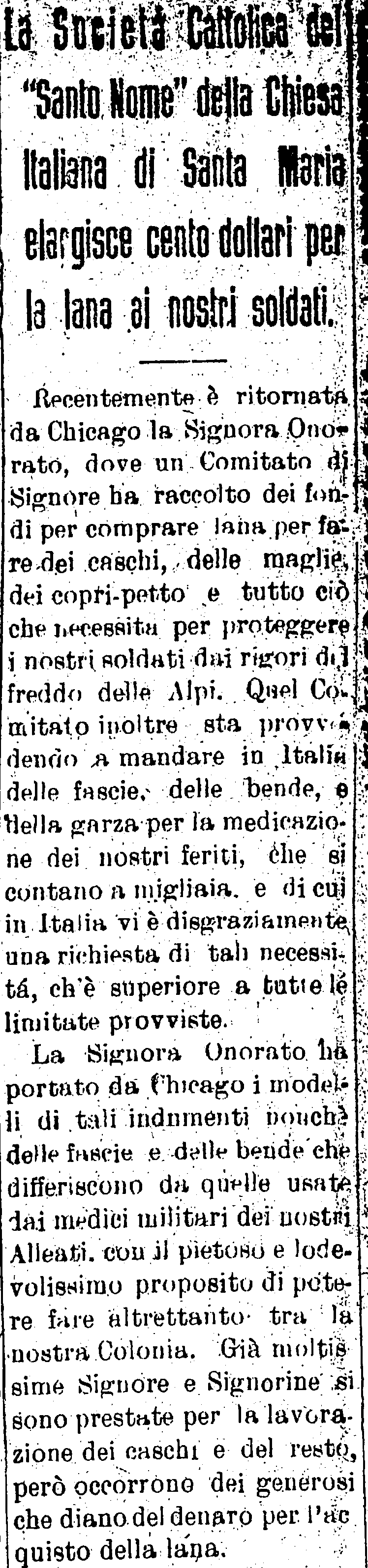
The Holy Name society at St. Mary’s Italian church contributed one hundred dollars to buy wool for soldiers in Italy. Signora Onorato, returning from Chicago, brought patterns for warm clothing and medical dressings. Women and girls in New Orleans were already volunteering their labor; the newspaper asked donors to supply materials. Care depended on coordinating money, practical knowledge and unpaid work.
Medical and Religious Care Across the Atlantic

The newspaper presented Giuseppe D’Anna’s planned journey to Italy with his portrait and new rank as an American army medical major. Donations from New Orleans would equip a five-hundred-bed field hospital named for Loyola University. American doctors and sixty-five nurses, principally Sisters of Charity, were expected to serve. The report made medical expertise and religious care part of a transatlantic patriotic obligation.
Orphans, Parish Pupils and the Sick

An announcement of a memorial service for Mother Francesca Saverio Cabrini described the Missionaries of the Sacred Heart’s work in New Orleans. For twenty-five years, the sisters had educated orphan girls, taught young people of both sexes at Santa Maria (St. Mary’s) and visited the sick. Praise for Mother Cabrini joined faith, practical care and service to Italian communities scattered across the world.
A Saint’s Feast in the Parish Calendar

St. Mary’s Italian parish announced worship for St. Joseph’s feast on 18 and 19 March. The program included masses, a solemn mass with a sermon praising the saint in Italian and participation by the Italian society bearing the saint’s name. An evening address would be given in English. Parish worship and associational membership brought religious belonging into the community’s organized public calendar.
Care and Collective Duty During the Epidemic

As influenza reached New Orleans, the newspaper relayed closures of churches, schools and entertainment venues, alongside Board of Health regulations. Household quarantine limited entry to relatives and necessary carers; hospital visits and ordinary funeral attendance were restricted. The Italian-language page called on residents to cooperate and observe hygiene. Protecting the community temporarily reshaped its worship, sociability and rituals around death.
Care and Worship at the Immigration Station

An Ellis Island reform report linked reception to everyday care: better lodging for women and children, supervised nutrition, laundry and interpreters. It also proposed Sunday Catholic, Jewish and Protestant services and access for welfare institutions’ representatives. L’Italo-Americano presented immigrant protection as a practical responsibility involving public administration, religious provision and help intended to continue during detention and after arrival.
Women Organize a Fair for Orphanage Care

Preparations for the Sacred Heart orphanage fair made charitable work a shared public duty. The notice names women directing stalls and refreshments, including Mrs G. Schilleci as general chairlady and Miss Santa Cangelosi at the fancy-work booth. Its appeal insists that children need affection as well as donations. An automobile parade and gifts promised to turn support for the sisters’ care into a community gathering.
A Benevolent Society Gathers for Worship

The Cefalutana society called members, their families and other devotees to a sung Mass at St. Mary’s in honor of the Holy Savior. President Frank D’Antoni’s invitation extended the society’s religious life beyond its membership. A society associated with a Sicilian hometown brought its patronal devotion into New Orleans’ Italian church, linking organized membership with family participation and a wider religious public.
A Sicilian Sanctuary Remembered in St. Mary’s

The Madonna del Monte Triona benevolent society planned a solemn Mass, an Italian sermon and Benediction at the Italian national Catholic church of St. Mary. Members and families were asked to honor their protectress together. The invitation addressed people from Bisacquino (Palermo) and recalled the sanctuary on Monte Triona, carrying a Sicilian sacred landscape into organized worship in New Orleans.
Cabrini’s Mission Reaches Beyond its Walls

The Missionary Sisters’ golden jubilee recalled Mother Cabrini’s 1892 arrival and linked the Day Home at 817 St. Philip Street with the Sacred Heart orphanage on Esplanade Avenue. The report describes visits to homes, markets, wharves and farms, Mass at two in the morning for fishermen and a fumigation demonstration during the 1905 yellow fever epidemic. Care extended beyond institutional walls.
Vows, Hospitality and Food for the Poor

St. Joseph’s altars joined vows, household labor and assistance to the poor. Despite wartime shortages and rationing, devotees planned displays and welcomed visitors. The account describes a ceremonial meal for people representing saints, followed by distribution of remaining food to poor people and other devotees. Mrs Luigi Schiro’s preparations and her account of her daughter’s recovery show women sustaining hospitality and religious memory.


