Alabama’s Italian newspapers brought the politics of Fascist Italy into the everyday life of Birmingham. Readers encountered Benito Mussolini through political commentary, photographs, poetry and reports of visits between Italy and the American South. These attachments developed alongside the interest in American citizenship and voting discussed earlier in the exhibition. The Columbus–Balbo Review, in particular, combined support for Fascist Italy with an active commitment to Italian Americans’ place in Alabama. Its pages connected national prestige abroad with recognition, influence and belonging at home.
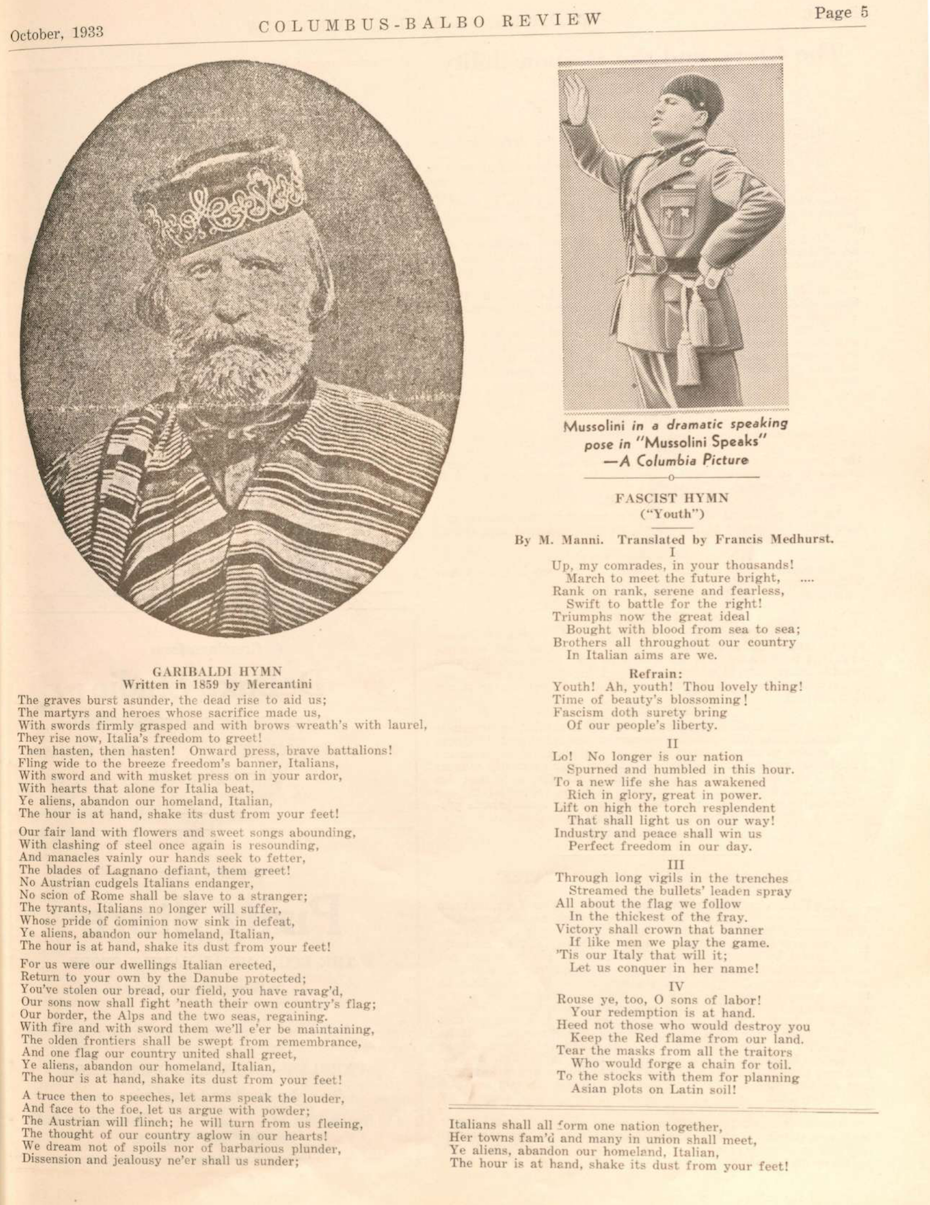
Garibaldi and Mussolini share this illustrated page, accompanied by English versions of the Garibaldi and Fascist hymns. Their placement presents Fascism as an heir to the struggle for Italian nationhood. Mussolini’s photograph comes from the film Mussolini Speaks: the memory of the Risorgimento appears beside a leader whose image circulated through modern cinema. English translation carried both patriotic traditions beyond an exclusively Italian-speaking readership.

During the Great Depression, Il Gladiatore used Mussolini’s name to argue for decisive leadership in the United States. The article praised him as a builder and organizer capable of confronting economic crisis. It also stated that America did not need an Italian-style dictatorship: the presidency already supplied considerable powers when exercised by a courageous leader. Its hoped-for “American Mussolini” would emerge from the suffering population and act against entrenched interests.

An American choosing Italian citizenship reversed the journey familiar to many of Il Gladiatore’s readers. George Nelson Page, a Virginian with longstanding family connections to Italy, announced his intention to renounce American citizenship and become a citizen of Fascist Italy. He preferred the discipline promised by Fascism to American liberalism. The article examined his reasoning and questioned whether people had really grown tired of liberty. Its closing comparison between Roosevelt’s recovery program and Italian Fascism brought Page’s choice back into American political debate.

This front-page report presented Mussolini’s assessment of Roosevelt’s economic recovery program. It discussed government intervention, industrial codes and inflation, before turning to Italy’s corporative legislation. For readers following the Depression from Alabama, the article placed American recovery and Italian economic policy within the same debate about the powers of government. Mussolini appeared as a commentator on problems affecting their lives in the United States.

The Review reported enthusiastically on a visit to Italy by Birmingham newspaper publisher Victor H. Hanson, Erskin Ramsay and Dr Charles B. Glenn, traveling as guests of the Italian government. Their accounts praised Mussolini and described land reclamation, housing and railway improvements as achievements of Fascist rule. Such endorsements gave the magazine’s admiration for Italy the backing of prominent figures from Birmingham.
The accompanying notice recorded a more personal connection. Editor Elviro Di Laura entrusted Hanson with a copy of the Review to present to Mussolini, enclosed in a special folder with Italian and American silk flags. Birmingham’s migrant magazine was thus seeking recognition in Rome through a local newspaper publisher.

Italian ambassador Augusto Rosso and Alabama governor Bibb Graves appeared together beneath a headline welcoming them to Birmingham. Their paired portraits gave Italy’s diplomatic presence a place within Alabama’s public life. For the Review, the occasion offered a prominent display of the connections joining its readers’ country of origin to the state in which they lived.

Alfredo Tancredi places a steel ring on his wife’s finger, replacing the gold wedding ring she had donated during the Fascist regime’s Oro alla Patria campaign. Launched in autumn 1935 under the slogan “Date oro alla patria” (“Give gold to the fatherland”), the campaign collected jewelry and precious metals to support Italy’s war in Ethiopia (1935–1936) and withstand the economic sanctions imposed by the League of Nations following the invasion. On 18 December 1935, the Giornata della Fede called on married Italians to surrender their gold wedding rings in exchange for metal substitutes, making marital attachment part of a public pledge to the nation. The Tancredis’ photograph records this mobilization’s reach into Birmingham. Its original caption played on fede, meaning both a wedding ring and faith, to praise the couple’s patriotic commitment. Published in the Columbus–Balbo Review in October 1936 and credited to the Birmingham Post, the photograph presented their donation to readers of both the migrant and local American press.

Ada Negri (1870–1945), whose early poetry had gained recognition for its treatment of poverty and labor, lent her literary reputation to Fascist mobilization through “L’Anello d’Acciaio” (“The Steel Ring”). The poem appeared in the Corriere della Sera on 18 December 1935, the Giornata della Fede, when Italians were called upon to donate their wedding rings as part of the Oro alla Patria campaign supporting the war in Ethiopia. Negri personifies Italy as a mother and bride wearing a steel ring offered by her people. Women of every social class, from the queen to the poorest donor, contribute the gold associated with their marriages, while the poem’s references to childbirth, affection and the family home give their sacrifice an intimate meaning. The steel replacement signifies the nation’s endurance in the face of sanctions, which Negri presents as unjust. Reprinted beside the Tancredi photograph in the Columbus–Balbo Review in October 1936, the poem placed a Birmingham family’s donation within this celebration of Italian women’s contribution to the Fascist war effort.

This article presented colonial settlement as an answer to the poverty, insecurity and humiliation associated with Italian emigration. It described plans to establish 15,000 farming families, approximately 75,000 people, in Ethiopia over four or five years. Selected for physical fitness, health and proven Fascist loyalty, settlers would receive government support and the prospect of owning the land they cultivated. The article contrasted this organized migration with the experience of Italians who had left their country in search of work and been abandoned to exploitation abroad. Under Fascism, it promised, Italians would leave as members of an imperial nation capable of securing land and protection for its people.
The racial foundations of that promise emerge in the expression “riempire di bianchi l’Etiopia”: to fill Ethiopia with white people. The settlers’ whiteness placed them above the African population within the colonial order, while their Italian nationality entitled them to the protection of the conquering state. Ethiopian inhabitants scarcely entered the account; the land appeared as a resource available for allocation to Italian families, whose labor would supposedly justify its possession. References to Rome and Italy’s long experience of colonization supplied historical legitimacy for this occupation. The article celebrated the prospect of Italians becoming property owners through a conquest that denied the conquered population the security and independence promised to the newcomers.
For readers in Jim Crow Alabama, this reversal of the emigrant’s position carried particular significance. Italians seeking recognition as respectable white Americans could identify with a national image in which their whiteness and authority were taken for granted. The despised or exploited immigrant became the European settler, protected by the state and entitled to command resources overseas. Colonial propaganda offered an answer to racial disparagement in the United States by associating Italians with the power and prestige of white imperial nations. Circulating this account in Birmingham connected the community’s pursuit of social standing to a wider racial hierarchy: the dignity promised to Italian migrants rested, in the Ethiopian example, on their privileged position over colonized Africans.

The October 1937 cover of the Columbus–Balbo Review paired Birmingham’s “Heaviest Corner in the World” with a poem by Primo Bartolini [LINK to exhibit], an Italian-born poet and language teacher who had settled in Nashville in 1908. Originally from Fanano, near Modena, Bartolini became one of the founders of the Nashville Conservatory of Music and established a public reputation through teaching, poetry and patriotic activity. His American military service and poems celebrating his adopted country helped make Italian literary accomplishment a recognized contribution to Southern civic life.

Primo Bartolini’s friendship with Elviro Di Laura connected the Italian communities of Nashville and Birmingham through educational advocacy and literary collaboration. The article accompanying the Italian flags discussed earlier in this exhibition, published in Il Gladiatore on 25 July 1931, recalled efforts to establish Italian teaching in Nashville. It referred to correspondence with a Vanderbilt University professor and identified Bartolini as the teacher of Italian at the Nashville Conservatory. Read alongside Bartolini’s consideration for a position at Vanderbilt in the early 1930s, this campaign shows how migrant intellectuals sought institutional recognition through relationships extending beyond their own city.

Their personal connection also found expression in Bartolini’s poem My Heart, dedicated to Di Laura and published in the Columbus–Balbo Review in December 1933. Teaching expertise, literary work and editorial support circulated between these Southern communities, giving Italian culture audiences and opportunities beyond the local immigrant association.
Bartolini’s Birmingham belongs to this exchange. Writing in English, a poet associated with Nashville celebrated another Southern city’s landscape, industry and hospitality: “Somehow I feel at home down here.” The poem closes with a direct address to Red Mountain and Vulcan, whose watchfulness combines protection of the city with a welcome to friends. Moretti’s sculpture becomes the recognizable voice of Birmingham in the work of another Italian immigrant. The encounter between Bartolini’s verse, Di Laura’s magazine and Moretti’s monument brings together three ways in which Italians contributed to the South’s public culture: through literature, the press and art.


