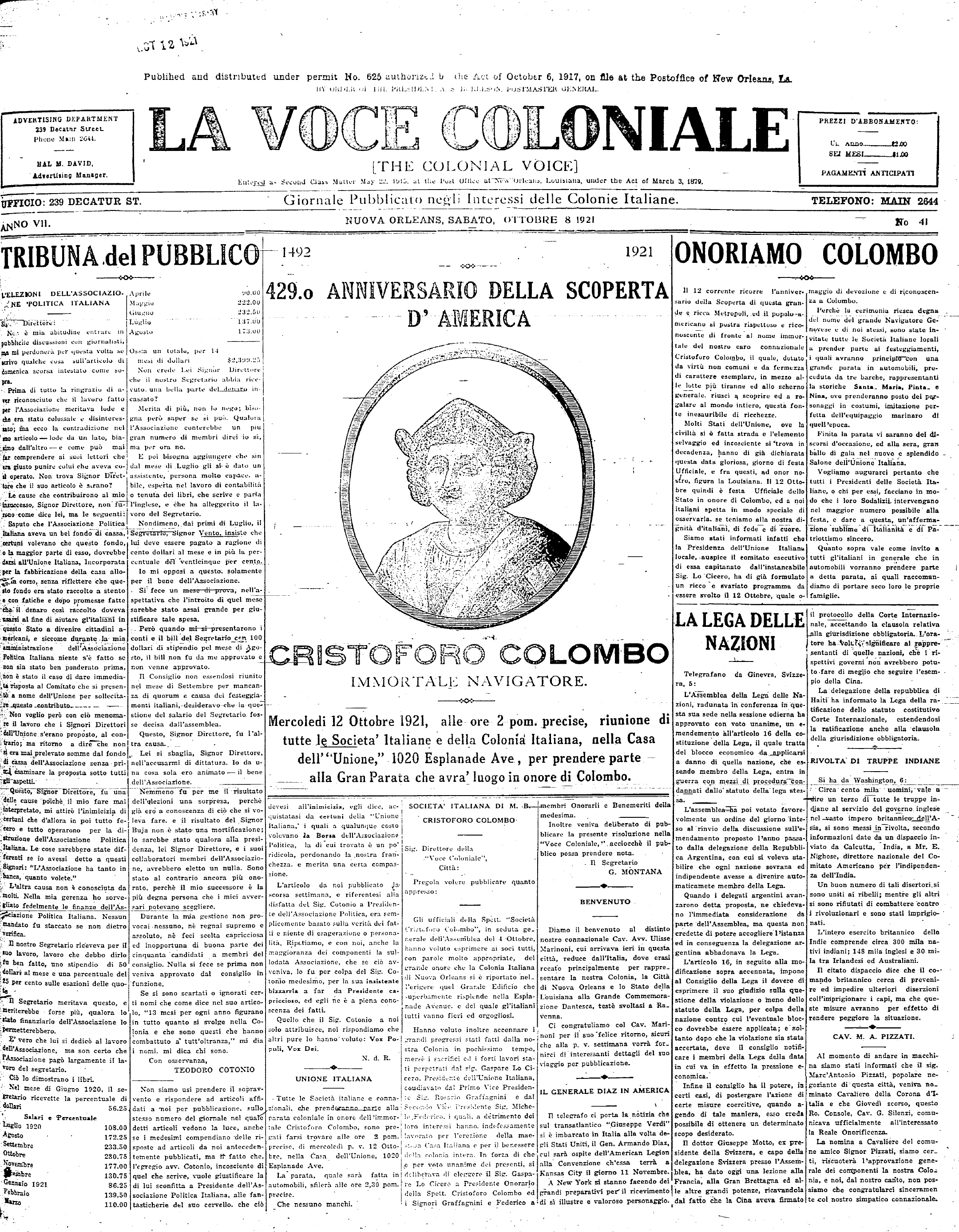
La Voce Coloniale, New Orleans, Louisiana, October 8, 1921. A portrait of Christopher Columbus occupied the center of the front page, while the appeal “Let Us Honor Columbus” appeared prominently in oversized type, marking the 429th anniversary of the discovery of America. La Voce reminded readers that October 12 was an official holiday in the state of Louisiana and called on all Italian societies and other members of the community to gather at the Unione Italiana Hall. From there, an automobile parade would set off, led by three floats representing the ships of Columbus’s expedition—Santa Maria, Pinta, and Niña—and carrying participants dressed as sailors of the period. Italians were explicitly invited to attend with their families. The observance thus brought Italian associations and families from the Unione Italiana Hall into the streets of New Orleans, making Columbus a public symbol of their presence in the city.
La Voce Coloniale, New Orleans (Louisiana), 8 ottobre 1921. Il ritratto di Cristoforo Colombo occupava il centro della prima pagina, mentre a caratteri cubitali campeggiava l’appello «Onoriamo Colombo», con cui il giornale celebrava il 429º anniversario della scoperta dell’America. La Voce ricordava che il 12 ottobre era festa ufficiale nello Stato della Louisiana e convocava tutte le società italiane e gli altri membri della comunità alla Casa dell’Unione. Da lì sarebbe partita una parata automobilistica, aperta da tre carri allegorici che riproducevano le navi della spedizione di Colombo – la SantaMaria, la Pinta e la Niña – e sui quali avrebbero presoposto figuranti in costume da marinai dell’epoca. Gli italiani erano espressamente invitati a partecipare con le proprie famiglie. La ricorrenza portava così le associazioni e le famiglie italiane dalla Casa dell’Unione nelle strade di New Orleans, facendo di Colombo un simbolo pubblico della loro presenza in città.

Columbus Balbo Review, Birmingham, Alabama, October 1933. The copy of the inaugural issue held at the Library of Congress bears the handwritten dedication “Compliments to Library of Congress from the publisher” and the signature of Elviro Di Laura, the magazine’s founder and editor and a former co-editor of Il Gladiatore. Published in English and sympathetic to fascism, the monthly offered Italian American readers a celebratory vision of Italian identity. The cover brought Columbus, Italo Balbo, Dante, Michelangelo, Giuseppe Verdi, and Guglielmo Marconi together in a single pantheon of Italian culture, art, science, and enterprise: the Columbus–Balbo pairing linked ocean navigation to the modern transatlantic flight of 1933. The two emblems of the National Recovery Administration, bearing the motto “We Do Our Part,” also situated this representation of Italy within New Deal America.
Columbus Balbo Review, Birmingham (Alabama), ottobre 1933. La copia del primo numero, conservata alla Library of Congress, reca la dedica autografa «Compliments to Library of Congress from the publisher» e la firma di Elviro Di Laura, fondatore e direttore della rivista, già condirettore de Il Gladiatore. Pubblicato in inglese e vicino al fascismo, il mensile proponeva ai lettori italo-americani una visione celebrativa dell’italianità. La copertina riuniva Colombo, Italo Balbo, Dante, Michelangelo, Giuseppe Verdi e Guglielmo Marconi in un unico pantheon della cultura, dell’arte, della scienza e dell’impresa italiane: il binomio Colombo-Balbo accostava la navigazione oceanica alla moderna trasvolata atlantica del 1933. I due emblemi della National Recovery Administration, con il motto «We Do Our Part», collocavano questa rappresentazione dell’Italia anche nell’America del New Deal.
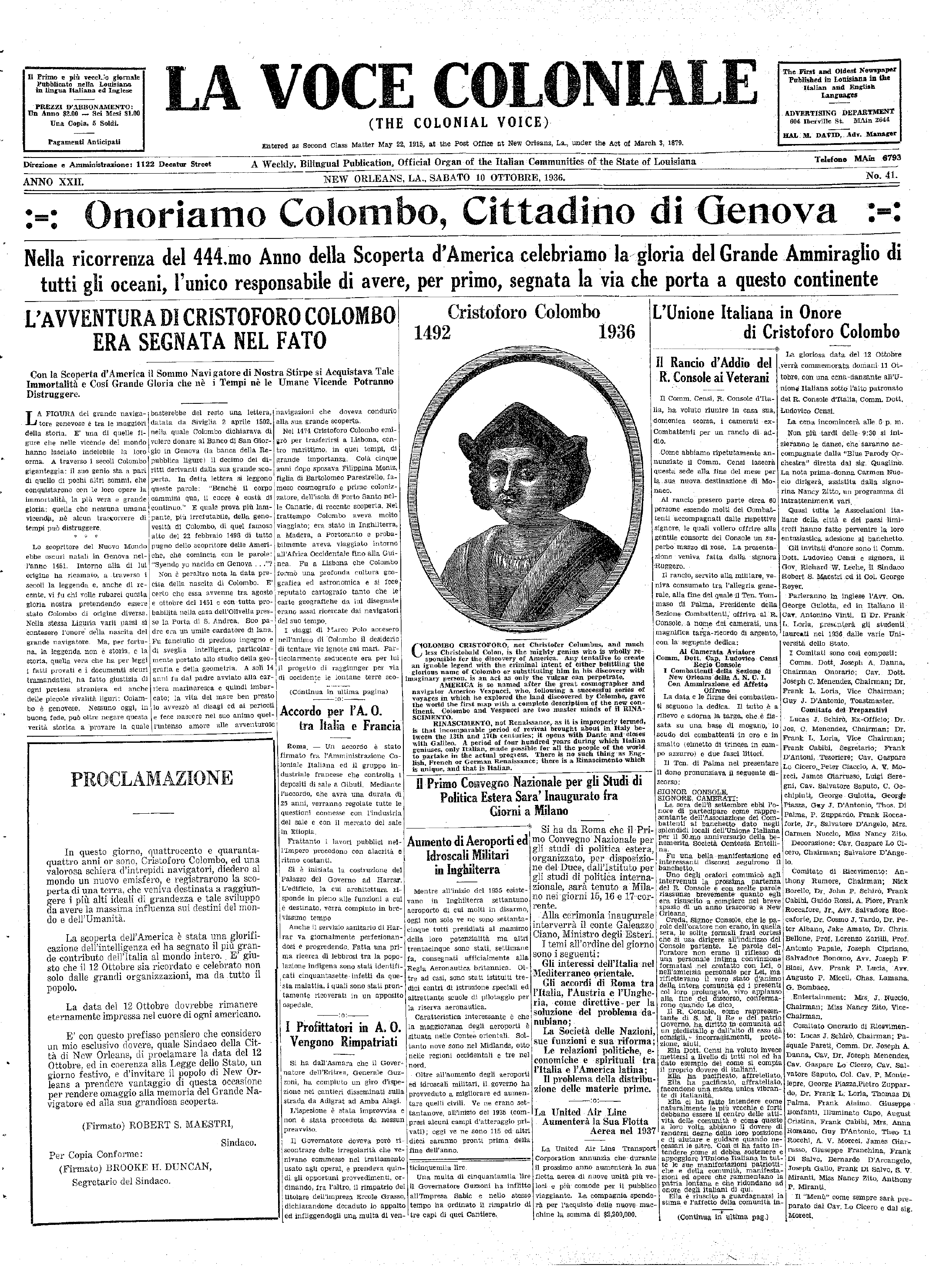
La Voce Coloniale, New Orleans,Louisiana, October 10, 1936. The headline “Let Us Honor Columbus, Citizen of Genoa” spanned the full width of the front page, which was dominated by a portrait of the navigator on the 444th anniversary of the discovery. The lead article recounted his life to assert his Genoese origins, also citing the autograph document dated February 22, 1498, in which Columbus wrote, “Syendo yo nacido en Genova” (“Since I was born in Genoa”). In his proclamation, Robert S. Maestri declared October 12 a holiday in New Orleans pursuant to the 1918 state law and invited the city’s entire population to pay tribute to the navigator. A businessman and the city’s first mayor of Italian descent, Maestri had taken office less than two months earlier and would remain in office until 1946; New Orleans’s second Italian American mayor would be Victor H. Schiro, who served from 1961 to 1970. For October 11, the Unione Italiana organized a dinner dance under the patronage of Consul Ludovico Censi, with the participation of nearly all the Italian associations in the city and neighboring communities. Guests of honor included Governor Richard W. Leche and Maestri himself. Columbus was thus presented as a source of Genoese pride, a symbol of Italian associational life, and a figure officially celebrated by both the city and the state.
La Voce Coloniale, New Orleans (Louisiana), 10 ottobre 1936. Il titolo «Onoriamo Colombo, cittadino di Genova» occupava l’intera larghezza della primapagina, dominata dal ritratto del navigatore nel 444º anniversario della scoperta. L’articolo principale ne ricostruiva la biografia per affermarne l’origine genovese, richiamando anche l’atto autografo del 22 febbraio 1498 nel quale «Syendo yo nacido en Genova». Nel suo proclama, Robert S. Maestri dichiarava il 12 ottobre giorno festivo a New Orleans in applicazione della legge statale del 1918 e invitava l’intera popolazione di New Orleans a rendere omaggio al navigatore. Uomo d’affari e primo sindaco di origine italiana della città, Maestri era entrato in carica da meno di due mesi e avrebbe governato fino al 1946; il secondo sindaco italo-americano di New Orleans sarebbe stato Victor H. Schiro, in carica dal 1961 al 1970. Per l’11 ottobre, l’Unione Italiana organizzava una cena danzante sotto il patrocinio del console Ludovico Censi, con l’adesione di quasi tutte le associazioni italiane della città e dei centri vicini. Tra gli invitati d’onore figuravano il governatore Richard W. Leche e lo stesso Maestri. Colombo era così presentato come gloria genovese, simbolo dell’associazionismo italiano e figura celebrata ufficialmente dalla città e dallo Stato.


